The Mariner’s Shipwreck and Rescue
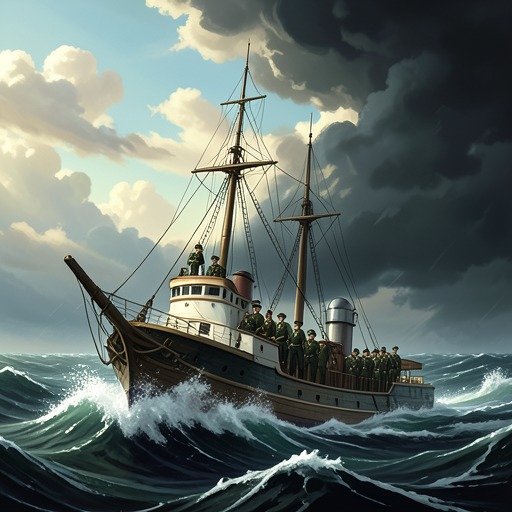
The Rime of the Ancient MarinerThe Mariner’s Shipwreck and Rescue brings the Ancient Mariner’s voyage to its violent end at the harbour where he hopes to return home. The ship sinks just as help reaches it; the Ancient Mariner survives, stunned and afloat, and finds himself in the Pilot’s boat. The scene’s decisive reversal is at once practical and uncanny: familiar signs of arrival, including oars, a Pilot, and the harbour-bar, frame the sudden loss of the ship, while the rescued man is left to face what his survival means.
Approach to Home
The rescue scene follows the Ancient Mariner’s return toward the coast. As the vessel crosses the harbour-bar, he recognizes the hill and the kirk and asks whether he is seeing his own country. The question marks the approach as more than a change of location: after the long voyage, the familiar shore offers the possibility of homecoming, but his words also reveal how uncertain and dreamlike that return feels. He prays to be awake, appealing to God as the ship drifts into the harbour.
The poem has already established the danger of a return propelled by forces beyond ordinary sailing. Earlier, the ship left harbour with its company cheering and dropped below the kirk and hill; later, a tyrannous Storm-Blast drove it onward with its overtaking wings. Near the end, the Ancient Mariner sees the coast again, but this apparent restoration does not simply reverse the voyage. The same recognisable landmarks that accompanied departure now frame a homecoming overshadowed by the supernatural events at sea.
That unease is sharpened by the ship’s manner of travel. After the dead crew rise, the helmsman steers and the ship moves on, although no breeze blows and the mariners work the ropes. The Ancient Mariner later hears the sound of oars and the Pilot’s cheer as rescue approaches. These details place the final scene within a world of recognisable maritime labour—steering, ropes, rowing, and harbour entry—even as the ship’s movement and fate exceed an ordinary account of navigation.
The Rescue Boat Approaches
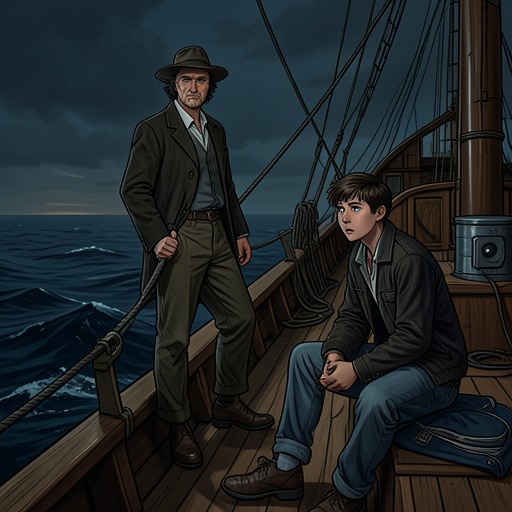
As the vessel nears shore, the Ancient Mariner hears the dash of oars and the Pilot’s call. He sees a third figure and recognizes the Hermit, who sings hymns. The approaching boat brings together the Pilot, the Pilot’s boy, and the Hermit, figures associated with the ordinary approach to land and with religious devotion. For the Ancient Mariner, their arrival offers a human point of contact after the voyage’s isolation and the dead crew’s silence.
The rescue is not immediate. The boat comes closer to the ship, but the Ancient Mariner neither speaks nor stirs. At the same time, the danger around the ship gathers force: beneath the water a rumbling grows louder and more dreadful. The two movements—boat toward ship and underwater sound toward its terrible conclusion—converge, so that the approach of help becomes inseparable from the moment of disaster.
The Ancient Mariner’s response to the Hermit’s presence carries a particular contrast. He has found joy in hearing the Hermit’s godly hymns, but the closeness of the boat leaves him motionless as the ship is about to sink. He is not presented as directing the rescue or escaping by his own action. The scene instead places him between the approaching human helpers and the overwhelming force that takes the vessel down.
The Ship Sinks
The underwater rumble reaches the ship and splits the bay. The vessel goes down like lead, an abrupt and complete reversal of the hoped-for return. The boat has come close beneath it, but the Ancient Mariner does not describe a conventional transfer from deck to rescue craft: the sinking stuns him, and his body lies afloat like that of someone drowned for seven days.
The poem gives the rescue in a compressed, dreamlike turn. Swift as dreams, the Ancient Mariner finds himself within the Pilot’s boat. The sequence holds two outcomes together without explaining the mechanics between them: the ship has vanished into the water, while its narrator has survived and is suddenly among his rescuers. The comparison with seven days drowned conveys the extremity of the shock, while the sudden arrival in the boat makes survival feel as uncanny as the forces that had driven the ship.
The Pilot’s boat therefore saves the Ancient Mariner at the very instant the ship is lost. The harbour has been reached, but the return does not restore the vessel, the voyage, or the crew. Instead, the Ancient Mariner is carried out of the catastrophe alone, and the ship’s destruction becomes the threshold between the supernatural passage home and the reckoning that follows.
Aftermath and Significance
The shipwreck completes the Ancient Mariner’s return but does not end his burden. His prayer at the harbour-bar expresses a desperate wish to be awake; after the ship goes down, he is safe in the Pilot’s boat, yet survival is not presented as a simple release. The poem separates the ship’s fate from the narrator’s: the vessel sinks, while the Ancient Mariner remains to tell what happened and to answer for it.
The scene’s force comes from the collision of maritime particulars and unexplained catastrophe. Oars sound; a Pilot calls; a boat approaches beneath the ship. Then the bay splits, the vessel sinks like lead, and the Ancient Mariner passes from apparent drowning into safety with dreamlike speed. The ordinary work of reaching harbour gives the supernatural reversal a concrete setting, while the abrupt rescue ensures that the final consequence of the voyage is not the Ancient Mariner’s death but his survival beyond the loss of the ship.